5 Signs of AML Non-Compliance in UAE Businesses And How to Fix Each One
The signs of AML non-compliance in UAE businesses are rarely loud. There is no alarm when your KYC forms are outdated. No warning light when your goAML registration has lapsed. No notification when your compliance officer’s responsibilities are too vague to satisfy the Ministry of Economy, the inspector.
Table of Contents
ToggleWhat happens quietly, and then all at once, is a regulatory inspection. And by that point, the penalties can be severe.
AED 100M
Maximum fine per violation under Federal Decree-Law No. 10 of 2025
300%+
Increase in DNFBP inspection rates by Ministry of Economy since 2021
AED 42M+
AML fines levied on non-financial businesses in UAE in 2025 alone
This guide is built specifically for UAE business owners, not compliance lawyers, not banks, who need a plain-language, actionable checklist to understand where their business stands right now.
To whom does AML compliance apply in the UAE? Under Federal Decree-Law No. 10 of 2025, AML compliance obligations apply to all financial institutions, banks, exchange houses, insurance providers, and Designated Non-Financial Businesses and Professions (DNFBPs), including real estate brokers, lawyers, accountants, corporate service providers, dealers in precious metals and gemstones, and virtual asset businesses. Free zone companies are not exempt.
The 5 Warning Signs And the Fix for Each
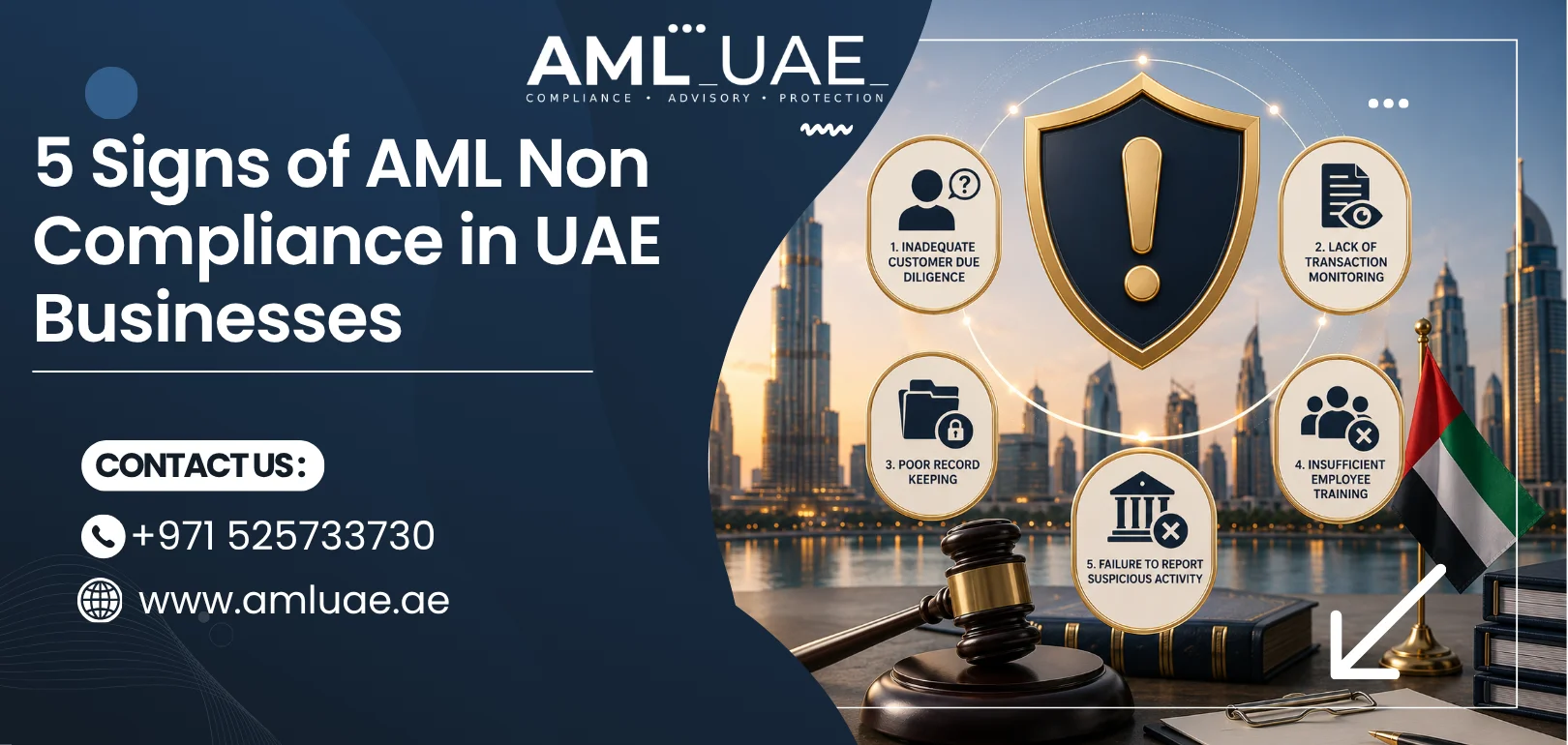
Sign 01: You Do Not Have a Written, Up-to-Date AML/CFT Policy
This is the single most common gap that regulators find during inspections of UAE businesses. Most companies either have no written AML/CFT policy at all or have one that was drafted years ago and never updated to reflect the new Federal Decree-Law No. 10 of 2025, which came into effect in October 2025.
An AML policy is not a one-time document. It must reflect your current business structure, your customer risk profile, the products and services you offer, and the latest regulatory standards. Under the current UAE framework, your policy must now explicitly address proliferation financing, a requirement that did not exist under the old 2018 law and that most existing policy templates completely miss.
What regulators look for: A current policy document, evidence of senior management sign-off, a record of when it was last reviewed, and whether it covers all three pillars of anti-money laundering (AML), counter-financing of terrorism (CFT), and counter-proliferation financing (CPF).
Warning signs to check:
- No written AML/CFT policy exists
- Policy was last updated before October 2025
- The policy does not mention proliferation financing (CPF)
- Senior management has not formally approved the policy
- Policy is generic, not tailored to your business and industry
Sign 02: Your Business Is Not Registered on goAML, or the Registration Has Gone Inactive
goAML registration in UAE is mandatory for all regulated entities, including all DNFBPs. It is the only channel through which Suspicious Transaction Reports (STRs), Suspicious Activity Reports (SARs), and Threshold Transaction Reports can be submitted to the UAE Financial Intelligence Unit (FIU).
What many business owners do not realize is that registering once is not enough. If no reports have been filed and no activity has been recorded for an extended period, the account can effectively become dormant, which raises a red flag for regulators who expect ongoing engagement.
More critically, failing to file an STR when you are legally required to do so is a criminal offense in the UAE. The law does not require certainty, only reasonable grounds to suspect. And under the tipping-off prohibition, you cannot inform a customer that a report has been filed.
What inspectors find most often: Businesses that registered on goAML during an earlier compliance drive but never filed a single report, and cannot explain why. Regulators interpret zero filings as evidence of zero monitoring, not evidence of a clean customer base.
Warning signs to check:
- Your business has never registered on the goAML portal
- goAML registration was completed, but no STRs have ever been filed
- Staff do not know how to identify or file a Suspicious Transaction Report
- No documented process exists for escalating suspicious activity internally
Need help with goAML registration and STR reporting?
We handle all UAE regulatory reporting obligations from goAML registration to STR and SAR filing accurately and on time.
Sign 03: Your KYC Process Is Inconsistent, Incomplete, or Relies on Outdated Documents
Know Your Customer (KYC) and Customer Due Diligence (CDD) are at the heart of AML compliance in Dubai and across the UAE. Yet this is the area where most businesses, even those that believe they are compliant, have dangerous gaps.
The most common gap that competitor guides overlook is the difference between collecting KYC documents and actually conducting due diligence. Many UAE businesses have KYC forms on file. Far fewer have a documented risk rating for each customer, a clear process for Enhanced Due Diligence (EDD) for high-risk clients, and a system for periodically reviewing and updating those records.
Under the current framework, your KYC obligations include verifying UBO (Ultimate Beneficial Ownership) for all corporate customers, screening against the UAE Local Terrorist List and the UN Consolidated List, and applying EDD to Politically Exposed Persons (PEPs). A photocopy of a passport and a trade license is not sufficient on its own.
What most competitors miss: Most AML compliance blogs focus on collecting KYC documents. What they don’t tell you is that regulators specifically check whether your customer risk ratings are documented and whether high-risk customers have received Enhanced Due Diligence, not just standard onboarding.
Warning signs to check:
- KYC forms do not capture Source of Funds, UBO information, or PEP status
- No risk-rating system exists to classify customers as low, medium, or high risk
- No EDD process for high-risk clients or PEPs
- Customer documents are not screened against sanctions lists at onboarding
- KYC records are not reviewed or refreshed periodically
Sign 04: No Appointed Compliance Officer or the Role Is a Job Title Without Real Responsibility
Many UAE businesses, particularly SMEs and DNFBPs, have technically appointed a compliance officer. Still, that person is also the CFO, the office manager, or the business owner themselves, with no dedicated time, authority, or training for the role.
UAE regulators are increasingly focused on this. During DNFBP compliance UAE inspections, the Ministry of Economy specifically requests the compliance officer’s CV, job description, and confirmation that they have access to all company records, including financials. They also want to know who the compliance officer reports to and whether they have the authority to escalate concerns independently.
An in-name-only appointment is a significant red flag. Regulators view it as evidence that the business is not genuinely committed to AML compliance, which affects how seriously they treat any other gaps they find.
Warning signs to check:
- No formally appointed compliance officer with a documented job description
- The compliance officer has no AML training or relevant qualifications
- The compliance officer does not have access to all the company’s financial records
- No clear reporting line from the compliance officer to senior management
- Senior management does not receive regular AML/CFT compliance reports
Sign 05: Your Staff Have Never Received Formal AML Training
AML compliance does not live only in policy documents and compliance officer reports. It lives in the day-to-day decisions made by your frontline staff, the person who onboards a new client, processes a large cash transaction, or receives an unusual payment request.
Under UAE AML compliance law, businesses are required to ensure that their staff are trained to identify financial crime, understand their reporting obligations, and know what to do and what not to do when a suspicious situation arises. This training must be role-specific, documented, and repeated regularly, not just delivered once during onboarding.
The hidden risk that most competitors’ blog posts completely ignore: untrained staff is often the cause of tipping-off violations. An employee who casually mentions to a client that their transaction “looked unusual” can expose your business to serious criminal liability, as informing a client about a suspicious transaction report is itself a criminal offense under UAE law.
Real consequence: A single untrained employee who tips off a client that their transaction has been flagged can result in criminal liability for both the employee and the business, regardless of whether the underlying compliance framework is otherwise sound.
Warning signs to check:
- Staff have never received formal AML/CFT training
- Training records are not documented or retained
- Training is generic, not tailored to staff roles and responsibilities
- Staff do not know what constitutes a suspicious transaction
- Staff are unaware of the tipping-off prohibition under UAE law
What AML Non-Compliance Actually Costs in UAE
Understanding the real cost of AML non-compliance penalties in UAE is a critical context for every business owner. The penalties introduced under Federal Decree-Law No. 10 of 2025 are significantly more severe than those under the previous 2018 framework.
Violation Type | Penalty Range | Severity |
Failure to implement AML/CFT policies | AED 50,000 – AED 5,000,000 per violation | High |
Failure to register on goAML or submit reports | AED 50,000 – AED 1,000,000 | High |
Inadequate KYC / customer due diligence | AED 50,000 – AED 5,000,000 | High |
Failure to maintain UBO records | AED 100,000+ | Medium–High |
Repeat violations (any category) | Up to double the original fine | High |
Serious/systematic violations | Up to AED 100,000,000 + possible dissolution | Critical |
Beyond financial penalties, non-compliant businesses in UAE also risk suspension of their trade licenses, termination of banking relationships, reputational damage, and, in serious cases, criminal prosecution of senior management, not just the company itself.
What Most AML Guides Don’t Tell You: The Hidden Compliance Gaps
After reviewing the top-ranking AML compliance UAE guides, here are the critical gaps that almost none of them address and that regulators actively look for.
1. Free zone companies are not exempt.
One of the most damaging misconceptions among UAE business owners is that free zone companies sit outside the scope of AML compliance obligations. They do not. Federal AML law applies across the mainland UAE, free zones, and designated financial zones.
2. Having the documents is not the same as being compliant.
Regulators are not looking for a folder of policies. They are testing whether your AML framework actually works in practice, with staff who can explain their obligations, transaction monitoring that generates documented outcomes, and a compliance officer who is genuinely active in the role.
3. Your AML checklist for UAE business must include an annual risk reassessment.
Your Enterprise-Wide Risk Assessment (EWRA) must be updated annually or whenever there is a material change to your business. A business that has grown significantly since its last risk assessment is almost certainly non-compliant in this area.
4. Compliance scaled to your size is still mandatory.
UAE regulators expect every regulated entity, including sole traders and small DNFBPs, to have a proportionate compliance framework. Proportionate does not mean minimal. It means demonstrably appropriate for your risk profile.
Is Your Business Showing Any of These Signs?
Don’t wait for an inspection to find out. Book a free consultation with our AML compliance specialists and get a clear picture of where your business stands, and exactly what needs to be done.