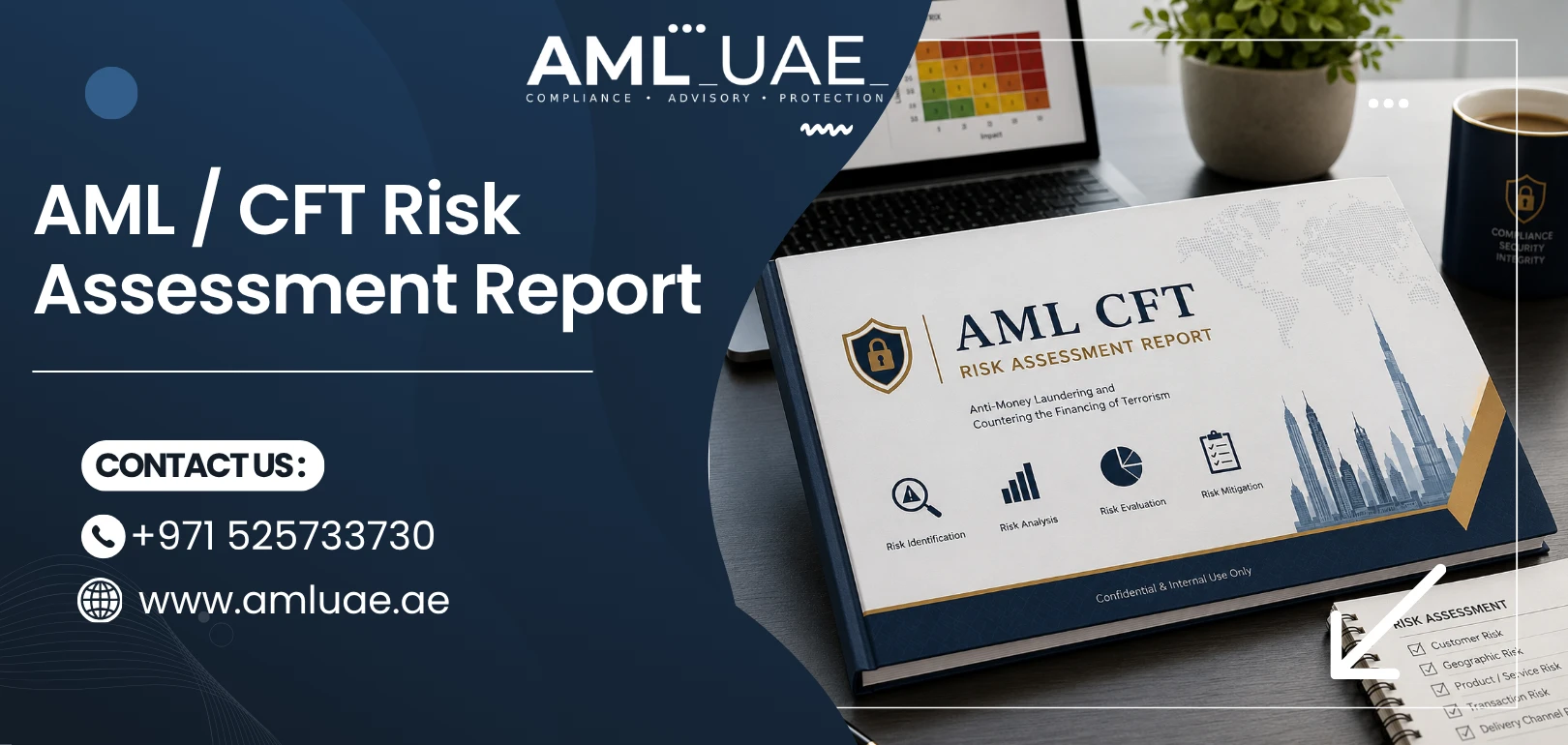
An AML CFT Risk Assessment Report is a documented assessment of a business’s exposure to money laundering (ML), terrorist financing (TF), and applicable proliferation financing (PF) risks. It identifies the risks faced by the organisation, evaluates their likelihood and impact, assesses existing controls, determines residual risk, and establishes measures to manage and mitigate those risks.
Table of Contents
ToggleIn the UAE, risk assessment is a fundamental part of the risk-based approach to AML/CFT compliance. Under Federal Decree by Law No. 10 of 2025, relevant Financial Institutions (FIs), Designated Non-Financial Businesses and Professions (DNFBPs), and Virtual Asset Service Providers (VASPs) are subject to requirements relating to identifying, assessing, managing, documenting, and continuously updating relevant financial crime risks. The law and its Executive Regulations form the current UAE AML/CFT legislative framework.
For a UAE business, an AML CFT risk assessment should therefore be more than a generic template. It should demonstrate that the organisation understands its own customers, products, services, transactions, geographic exposure, delivery channels and vulnerabilities.
Quick Answer: What Is an AML CFT Risk Assessment Report?
An AML CFT Risk Assessment Report is a formal document that evaluates an organisation’s exposure to money laundering, terrorist financing and, where applicable, proliferation financing.
It normally covers:
- Customer risk
- Geographic or country risk
- Product and service risk
- Transaction risk
- Delivery-channel risk
- Inherent risk
- Existing AML/CFT controls
- Control effectiveness
- Residual risk
- Risk mitigation measures
The purpose is to establish a business-specific risk profile and ensure that AML/CFT controls are proportionate to the risks identified.
Is AML CFT Risk Assessment Mandatory in the UAE?
Yes. Risk assessment is an important component of the UAE’s AML/CFT framework.
Federal Decree by Law No. 10 of 2025 requires relevant entities to identify, understand, assess, manage, document and continuously update risks associated with money laundering, terrorist financing and proliferation financing within their business scope. The legislation also provides for retaining the risk assessment study and related information and making it available to the relevant supervisory authority when required.
The Executive Regulations under Cabinet Resolution No. 134 of 2025 further establish requirements applicable to Financial Institutions, DNFBPs and VASPs, including risk-based measures and the assessment of risks arising from new products, business practices, delivery mechanisms and technologies.
This means that businesses should not treat an AML risk assessment as a one-time document prepared only before a regulatory inspection.
Who Needs an AML CFT Risk Assessment Report in the UAE?
AML/CFT risk assessment requirements apply to relevant regulated entities under the UAE framework, including Financial Institutions, DNFBPs and Virtual Asset Service Providers, subject to their applicable regulatory requirements.
For DNFBPs, this can include businesses such as:
Real Estate Brokers and Agents
Real estate activities can present ML risks because of high-value transactions, international customers, complex ownership structures and different payment arrangements.
Dealers in Precious Metals and Stones
Gold and precious metals businesses may face exposure to high-value transactions, cash-intensive activity, international customers and other financial crime risks.
Auditors and Accountants
Professional service providers should consider the risks associated with their customers, services, jurisdictions, transactions and business relationships.
Corporate and Trust Service Providers
TCSPs can face risks associated with company formation, complex ownership structures, beneficial ownership and international relationships.
Other Relevant DNFBPs
The exact risk profile depends on the nature, size and complexity of the business. A risk assessment should therefore be tailored to the actual activities of the organisation rather than copied from another sector.
Why Is an AML CFT Risk Assessment Important?
The primary purpose of an AML CFT risk assessment is to help a business understand where its financial crime risks come from and how effectively those risks are being controlled.
A strong risk assessment helps management:
- Understand the organisation’s overall ML/TF/PF exposure.
- Identify higher-risk customers and activities.
- Determine appropriate CDD and EDD measures.
- Strengthen transaction monitoring.
- Improve sanctions and PEP screening controls.
- Allocate compliance resources according to risk.
- Identify weaknesses in existing AML controls.
- Support AML/CFT policies and procedures.
- Demonstrate a risk-based approach during regulatory reviews.
The assessment also creates a connection between the company’s risk profile and its AML compliance programme.
For example, if a business identifies high geographic risk, its AML procedures should explain how that risk is managed. If complex ownership structures are identified as a significant vulnerability, beneficial ownership and enhanced due diligence controls should address that exposure.
What Should an AML CFT Risk Assessment Report Contain?
There is no single generic document that is appropriate for every UAE business. The assessment should reflect the organisation’s actual activities, risk profile and applicable regulatory requirements.
However, a comprehensive AML CFT Risk Assessment Report UAE will generally contain the following sections.
1. Executive Summary
The executive summary provides a high-level overview of the organisation, its major AML/CFT risks, overall risk rating and key mitigation measures.
Senior management should be able to understand the most important conclusions without reading the entire report.
2. Business Profile
The report should explain what the business does.
This section can cover:
- Business activities
- Products and services
- Customer types
- Geographic locations
- Transaction types
- Delivery channels
- Ownership and management structure
- Business size and complexity
A risk assessment cannot be meaningful if the underlying business model is not properly understood.
3. AML CFT Risk Assessment Methodology
The methodology explains how the organisation calculates and classifies risk.
It should establish the relevant risk factors, scoring approach, weighting methodology and risk categories.
For example, a business may classify risks as:
Low Risk → Medium Risk → High Risk
Some organisations may use more detailed scoring systems, provided the methodology is logical, consistently applied and appropriate to the business.
The methodology should also explain how inherent risk, control effectiveness and residual risk are determined.
Is your current AML policy a generic template that does not reflect your actual business?
AMLUAE produces fully customised AML CFT policy documentation UAE tailored to your specific business type, risk profile, client base, and regulatory obligations under Federal Decree-Law No. 10 of 2025.
What Are the Main AML CFT Risk Factors?
Customer Risk
Customer risk considers who the organisation is dealing with.
Relevant factors can include the customer’s:
- Identity
- Business activity
- Ownership structure
- Beneficial owners
- PEP status
- Sanctions exposure
- Geographic connections
- Source of funds
- Source of wealth, where applicable
- Transaction behaviour
- Adverse information
The importance of each factor will depend on the nature of the business.
Geographic Risk
Geographic risk considers the countries and jurisdictions connected to customers, transactions and business operations.
A business may consider factors such as:
- High-risk jurisdictions
- Countries subject to increased monitoring
- Sanctions exposure
- Financial crime vulnerabilities
- Corruption risks
- Terrorist financing exposure
- Proliferation financing concerns
Country risk should be evaluated using current and relevant information rather than relying indefinitely on an outdated list.
Product and Service Risk
Different products and services can expose a business to different levels of ML/TF risk.
A business should identify which products or services may be more vulnerable and explain the controls applied to those activities.
Transaction Risk
Transaction risk considers the characteristics and behaviour of transactions.
Relevant factors can include transaction value, frequency, complexity, cross-border activity, unusual patterns, third-party payments and activity inconsistent with the customer’s known profile.
Delivery Channel Risk
The method used to establish and maintain customer relationships can also affect risk.
Examples include:
- Face-to-face onboarding
- Remote onboarding
- Online services
- Intermediaries
- Digital platforms
- Third-party service providers
The organisation should assess whether its delivery channels create additional vulnerabilities and whether additional controls are necessary.
What Is Inherent Risk in AML?
Inherent risk is the level of ML/TF/PF risk that exists before considering the effectiveness of the organisation’s controls.
For example, a business serving international customers, handling complex transactions and operating across multiple jurisdictions may have a higher inherent risk profile.
The organisation should assess the relevant risk factors and establish an overall inherent risk rating.
What Is Residual Risk in AML?
Residual risk is the level of risk that remains after considering the organisation’s existing controls.
This distinction is important.
A company may have a high inherent risk but strong controls that reduce its residual risk. Conversely, a company may have moderate inherent risk but weak controls, resulting in significant residual exposure.
A good AML CFT risk assessment should therefore evaluate both the risk itself and the effectiveness of the controls used to manage it.
How to Prepare an AML CFT Risk Assessment Report in the UAE
A practical AML CFT risk assessment process can be structured into the following stages.
Step 1: Understand the Business
Document the company’s activities, customers, services, transactions, jurisdictions, and delivery channels.
Step 2: Identify ML/TF/PF Risks
Identify the threats and vulnerabilities associated with the business.
Step 3: Assess Inherent Risk
Evaluate the identified risks before considering existing controls.
Step 4: Review Existing Controls
Assess CDD, EDD, sanctions screening, PEP screening, transaction monitoring, suspicious transaction reporting, training, record keeping and other AML controls relevant to the business.
Step 5: Assess Control Effectiveness
Determine whether the controls are properly designed and effectively implemented.
Step 6: Determine Residual Risk
Calculate the risk remaining after existing controls have been considered.
Step 7: Identify Risk Gaps
Determine where additional controls or improvements are required.
Step 8: Establish a Mitigation Plan
Set out the actions required to reduce unacceptable or excessive risks.
Step 9: Obtain Management Approval
The final assessment should be reviewed by the appropriate management or governance function.
Step 10: Monitor and Update
The assessment should be reviewed when there are material changes to the business, risks, products, services, customers, technology, jurisdictions or applicable regulatory requirements.
How Should AML Risk Be Scored?
There is no single scoring model that should automatically be applied to every UAE business.
A business may develop a scoring framework based on factors such as:
Likelihood × Impact = Risk Score
For example, the organisation may assign numerical values to different risk factors and then establish thresholds for low, medium and high risk.
However, the scoring system should not become a substitute for professional judgement.
The most important question is whether the methodology produces a reasonable and explainable assessment of the organisation’s actual risks.
AML CFT Risk Assessment for DNFBPs
DNFBPs should pay particular attention to the risks associated with their specific sectors.
For example, a real estate business may focus on property values, customer jurisdictions, beneficial ownership, payment methods and unusual transactions.
A dealer in precious metals and stones may need to consider high-value transactions, cash exposure, customer profiles and geographic risk.
A corporate service provider may focus more heavily on complex structures, beneficial ownership, international relationships and the purpose of the business relationship.
This demonstrates why a generic AML risk assessment template UAE should only be used as a starting framework.
AML CFT Risk Assessment vs Customer Risk Assessment
An AML CFT business risk assessment and a Customer Risk Assessment (CRA) are different.
A business risk assessment evaluates the organisation’s overall exposure to ML/TF/PF risks.
A customer risk assessment evaluates the risk associated with a specific customer or business relationship.
For example, a real estate broker could identify international customers and complex ownership structures as significant risks at the business level.
The broker would then evaluate each individual customer to determine that customer’s specific risk profile.
The two assessments should work together within the organisation’s overall risk-based approach.
When Should an AML CFT Risk Assessment Be Updated?
An AML CFT risk assessment should not remain unchanged when the business or its risk environment changes.
Potential triggers for an update include:
- New products or services
- New customer categories
- Expansion into new countries
- New delivery channels
- Significant transaction changes
- New technologies
- Changes in ownership or business structure
- New ML/TF/PF typologies
- Changes in applicable laws or regulations
- Internal audit findings
- Compliance review findings
- Regulatory examination findings
The current UAE Executive Regulations specifically address the need to identify and assess ML/TF/PF risks arising from new products, new business practices, new delivery mechanisms and new or emerging technologies, including before their launch or use.
Common AML Risk Assessment Mistakes
Using a Generic Template
A document that simply replaces another company’s name does not demonstrate a genuine understanding of the organisation’s risk profile.
Focusing Only on Customer Risk
Customer risk is important, but geographic, product, transaction and delivery-channel risks should also be considered where relevant.
Having No Clear Methodology
A report should explain how risk ratings were determined.
Ignoring Control Effectiveness
A risk assessment should consider whether existing AML controls actually reduce identified risks.
Not Connecting the Assessment to AML Policies
The findings should influence CDD, EDD, monitoring, screening, training and other controls.
Treating the Report as a One-Time Exercise
Risk assessment is an ongoing compliance activity. Changes to the business and risk environment may require the assessment to be reviewed and updated.
What Evidence Should Support an AML CFT Risk Assessment?
A risk assessment should be supported by relevant information rather than unsupported statements.
Depending on the organisation, supporting information may include customer data, transaction information, geographic exposure, product and service information, internal compliance findings, previous suspicious activity information, audit findings, regulatory guidance and relevant external risk information.
The evidence used should be appropriate to the size, nature and complexity of the organisation.
Can You Use an AML CFT Risk Assessment Template?
Yes, a template can help organise the assessment, but it should not replace a business-specific AML CFT risk assessment.
A suitable template should be customised to reflect the organisation’s:
- Business model
- Customer profile
- Products and services
- Transaction profile
- Geographic exposure
- Delivery channels
- Ownership structure
- AML controls
- Risk appetite
- Applicable supervisory requirements
The final document should explain why the organisation has identified particular risks and how those risks are being managed.
What Do UAE Regulators Look for in an AML Risk Assessment?
The title of the document is not what matters most.
A strong assessment should demonstrate that the organisation:
Understands its risks.
The business should be able to explain where its ML/TF/PF risks originate.
Uses a documented methodology.
Risk ratings should have a logical basis.
Applies a risk-based approach.
Higher risks should receive proportionate mitigation.
Maintains effective controls.
The assessment should connect identified risks to actual AML controls.
Keeps the assessment current.
Material changes should be reflected in the risk assessment.
Maintains supporting documentation.
The organisation should be able to demonstrate the basis for its conclusions.
Under the UAE’s current AML framework, relevant entities are required to document and manage applicable risks and maintain relevant risk assessment information in accordance with the law and applicable regulatory requirements.
Final Takeaway
An AML CFT Risk Assessment Report UAE is not simply a compliance document. It is the foundation for developing a proportionate and effective AML/CFT programme.
A strong assessment should identify the organisation’s actual ML/TF/PF risks, evaluate inherent risk, assess existing controls, determine residual risk and establish practical mitigation measures.
For UAE businesses, particularly DNFBPs, the assessment should be business-specific, evidence-based, documented, risk-based and regularly reviewed.
A generic report may look complete on paper but fail to demonstrate how the organisation actually understands and manages its financial crime risks.
If your business needs an AML CFT Risk Assessment Report in the UAE, AML UAE can help prepare or review a business-specific assessment aligned with the applicable UAE AML/CFT framework, your sector, business activities and risk profile.