Customer Due Diligence (CDD) is one of the most important components of an effective Anti-Money Laundering and Counter-Terrorist Financing framework. It enables a business to understand who its customer is, who ultimately owns or controls the customer, why the customer wants to establish a relationship, what activity is expected, and whether the relationship presents money laundering, terrorist financing or proliferation financing risks.

What Is MENAFATF? Members, Observers & UAE AML Guide
MENAFATF, or the Middle East and North Africa Financial Action Task Force, is a FATF-Style Regional Body (FSRB) responsible for strengthening anti-money laundering, counter-terrorist financing, and counter-proliferation financing standards across the Middle East and North Africa region.
The Role of Re-KYC Process in AML Compliance in the UAE
Re-KYC is an important part of ongoing Anti-Money Laundering (AML) compliance. While KYC begins when a customer is onboarded, Re-KYC ensures that customer information, beneficial ownership, risk profiles, and expected activities remain accurate throughout the business relationship.
AML Compliance for Real Estate Agents and Brokers in UAE: The Complete Guide
AML compliance Real Estate Agents UAE is the most actively enforced DNFBP obligation in the country, and the enforcement data proves it. In the first half of 2025, the Ministry of Economy found 495 AML violations specifically from real estate businesses, the highest number of any single DNFBP category, and issued fines exceeding AED 42 million across all DNFBPs in the same period.
AML Compliance for Corporate Service Providers in UAE 2026: The Complete Guide
AML compliance corporate service providers UAE 2026 is not what it was under the 2018 framework, and the change is more significant than most company formation agents, registered office providers, nominee directors, trust service providers, and PRO services companies in the UAE currently realise.
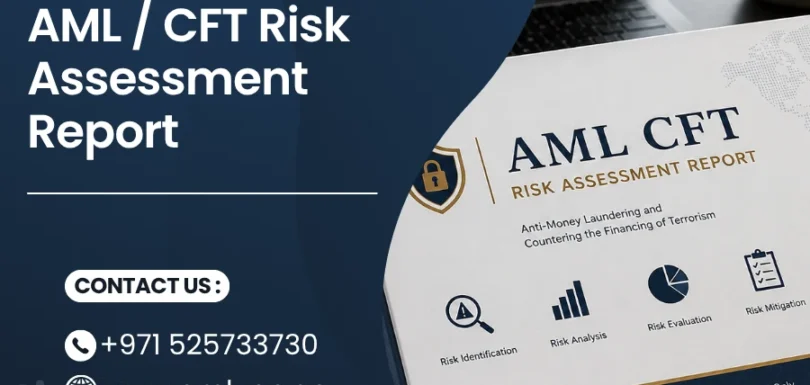
AML CFT Risk Assessment Report UAE: Complete 2026 Guide
An AML CFT Risk Assessment Report is a documented assessment of a business's exposure to money laundering (ML), terrorist financing (TF), and applicable proliferation financing (PF) risks. It identifies the risks faced by the organisation, evaluates their likelihood and impact, assesses existing controls, determines residual risk, and establishes measures to manage and mitigate those risks.