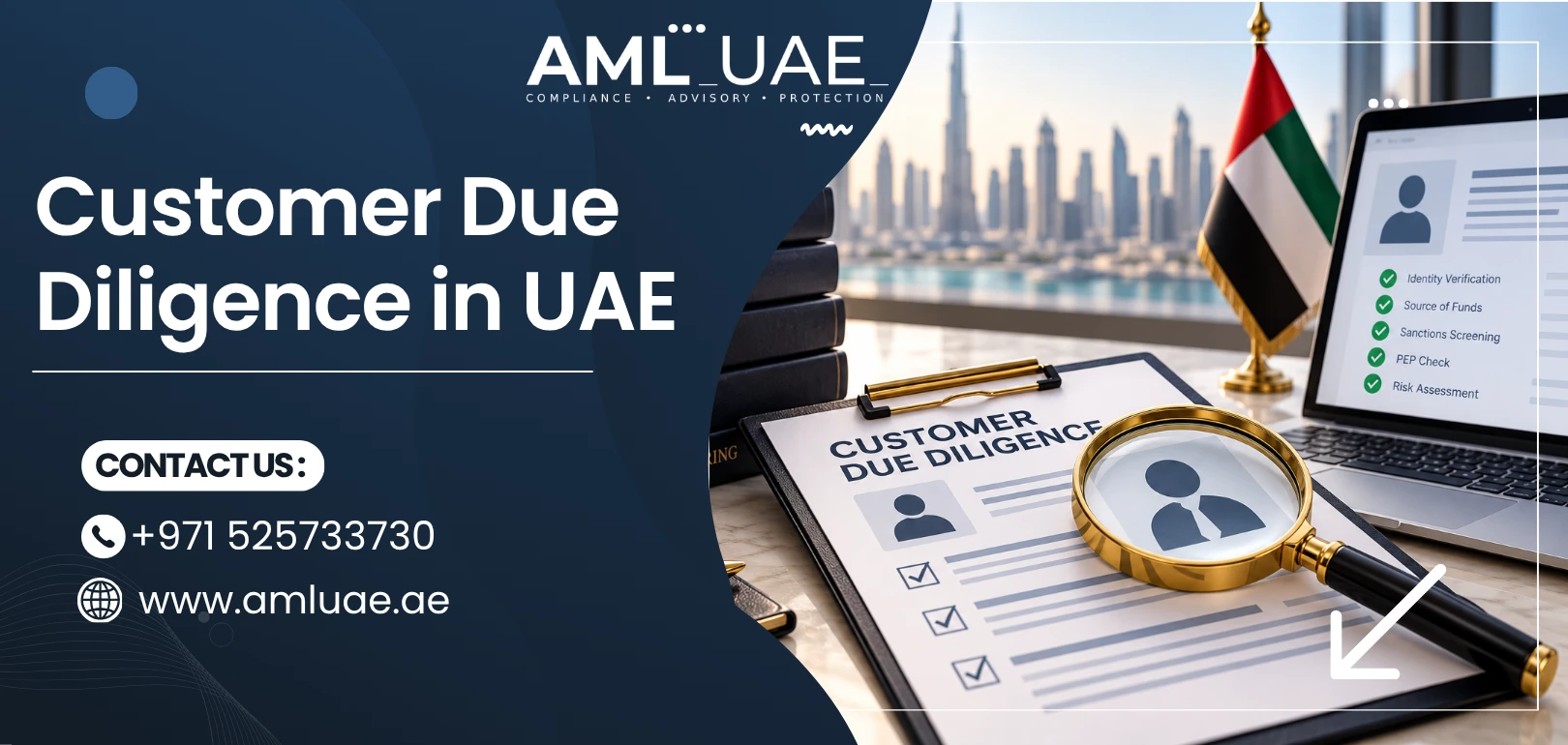
Customer Due Diligence (CDD) is one of the most important components of an effective Anti-Money Laundering and Counter-Terrorist Financing framework. It enables a business to understand who its customer is, who ultimately owns or controls the customer, why the customer wants to establish a relationship, what activity is expected, and whether the relationship presents money laundering, terrorist financing or proliferation financing risks.
Table of Contents
ToggleFor businesses operating in the UAE, Customer Due Diligence is not simply a document-collection exercise. An effective CDD framework connects KYC, customer identification, beneficial ownership, customer risk assessment, source of funds, source of wealth, sanctions screening, PEP screening, transaction monitoring and ongoing review.
The CDD requirements applicable to a business depend on its regulatory status, sector, customers and risk profile. The UAE framework is also connected to international standards developed by the Financial Action Task Force (FATF). CBUAE guidance describes CDD as including customer identification and verification, beneficial-owner identification, understanding the nature and purpose of the relationship, and ongoing monitoring, including periodic and event-driven updates.
For companies researching AML UAE, UAE AML, AML in UAE, or UAE money laundering compliance, understanding how CDD fits into the wider AML framework is essential.
Key Takeaways
Customer Due Diligence is the process through which a regulated business identifies and verifies its customer, understands the beneficial owner, establishes the purpose and expected nature of the relationship, assesses risk and conducts appropriate ongoing monitoring.
In the UAE, effective CDD should be risk-based. The depth and frequency of measures should reflect the risks associated with the customer, relationship, product, service, transaction, and geographic exposure.
CDD is closely connected with KYC, but the terms are not interchangeable. KYC generally focuses on knowing and verifying the customer, while CDD encompasses a broader risk-management process that continues throughout the business relationship.
Higher-risk relationships may require Enhanced Due Diligence, while simplified measures may be appropriate where the applicable framework permits them and the risk is demonstrably lower.
A strong CDD framework should also address beneficial ownership, sanctions, PEPs, adverse media, source of funds, source of wealth, transaction monitoring, record keeping and suspicious activity escalation.
What Is Customer Due Diligence?
Customer Due Diligence, commonly abbreviated as CDD, is the process used by a regulated entity to identify and understand its customers and manage the risks associated with a business relationship or transaction.
At a basic level, CDD answers four important questions. Who is the customer? Who ultimately owns or controls the customer? Why is the customer establishing the relationship? What activity should the business reasonably expect from that relationship?
However, effective CDD goes further. The business should use the information gathered during onboarding to establish a customer risk profile and then use that profile during ongoing monitoring.
The FATF framework identifies customer identification and verification, beneficial-owner identification and verification, understanding the purpose and intended nature of the relationship, and ongoing due diligence as core CDD measures. FATF also states that the extent of CDD should be risk-sensitive.
This means CDD should not be treated as a one-time formality. Customer circumstances, ownership, geography, products, services and transaction behaviour can change, so the business needs processes for keeping its understanding of the relationship current.
What Is CDD in AML Compliance?
CDD is a core preventive control within an AML/CFT program.
A business uses CDD to establish a reasonable understanding of its customers and identify circumstances that could indicate increased exposure to money laundering, terrorist financing, or proliferation financing.
An effective CDD program helps a business decide how much information to obtain, how deeply to verify that information, how frequently to review the relationship, and whether additional controls such as Enhanced Due Diligence are appropriate.
This is why AML Customer Due Diligence should be connected directly to the organization’s overall AML risk assessment rather than operating as an isolated onboarding procedure.
What Are the Four Core Customer Due Diligence Requirements?
The four core elements commonly associated with CDD are customer identification and verification, beneficial-owner identification and verification, understanding the purpose and intended nature of the business relationship, and ongoing due diligence.
Customer identification establishes who the customer is and involves obtaining appropriate information and verifying it using reliable and independent sources.
Beneficial-owner identification establishes who ultimately owns or controls a legal person or arrangement.
Understanding the purpose and intended nature of the relationship allows the business to establish an expected customer profile.
Ongoing due diligence then allows the business to compare actual activity with that understanding and update customer information and risk assessments when circumstances change.
The CBUAE’s current Rulebook reflects this structure and specifically refers to periodic and event-driven updating of customer information, beneficial ownership information and customer risk profiles.
Customer Due Diligence UAE: What Does the UAE Framework Require?
The UAE AML/CFT framework requires applicable reporting entities to implement appropriate customer due diligence measures.
The precise requirements depend on the type of entity and its regulatory framework. Financial institutions, relevant DNFBPs and virtual asset service providers can have different supervisory requirements, so businesses should not rely on a generic CDD checklist without considering their sector.
For licensed financial institutions, the CBUAE Rulebook provides detailed CDD guidance covering customer identification, beneficial ownership, risk profiling, source of funds and source of wealth, expected activity, geographic risk, ongoing monitoring, simplified due diligence, enhanced due diligence, name screening and other controls.
For this reason, Customer Due Diligence UAE should be designed around the applicable legal and regulatory requirements rather than copied from another jurisdiction.
Does your real estate agency’s AML framework pass a Ministry of Economy inspection standard?
AMLUAE’s AML/CFT Health Check, delivered by specialist AML compliance consultants, assesses every element inspectors check, giving you a gap report and remediation roadmap before a regulator arrives.
When Is Customer Due Diligence Required in the UAE?
CDD generally becomes relevant when an applicable reporting entity establishes a business relationship, conducts certain occasional transactions, encounters suspicion of money laundering or terrorist financing, or has doubts about previously obtained customer identification information.
For financial institutions, the CBUAE states that CDD should be conducted before or during establishment of a business relationship or account, or before executing an applicable transaction for a customer with whom there is no business relationship.
The exact circumstances and thresholds can differ by sector and regulatory framework. Businesses should therefore verify the requirements applicable to their activities rather than applying one threshold universally.
Who Needs to Conduct CDD in the UAE?
Customer Due Diligence obligations apply to relevant reporting entities subject to UAE AML/CFT requirements.
Depending on the applicable framework, these can include financial institutions and relevant DNFBPs such as dealers in precious metals and stones, real estate agents and brokers, auditors and independent accountants, and certain legal and corporate service providers. Virtual asset service providers are also subject to applicable AML/CFT requirements.
The purpose of these requirements is to prevent businesses and financial systems from being misused for financial crime.
A company should first determine whether it falls within an applicable reporting-entity category and then establish its CDD framework accordingly.
KYC vs CDD: What Is the Difference?
KYC and CDD are closely connected but should not be treated as identical concepts.
KYC, or Know Your Customer, is primarily concerned with obtaining and verifying information that establishes the identity of a customer.
CDD is broader. It incorporates customer identification and verification but also addresses beneficial ownership, the purpose and intended nature of the relationship, customer risk, and ongoing monitoring.
In simple terms, KYC helps answer “Who is the customer?”, while CDD asks a broader question: “Who is the customer, who controls or benefits from the relationship, why are they using our services, what risks do they present, and does their activity remain consistent with what we know?”
Customer Identification and Verification
Customer identification is the starting point of CDD.
For an individual, relevant information may include the person’s legal name, date of birth, nationality, address, identification details, and other information required under the applicable framework.
For a legal entity, the business may need to understand the entity’s legal name, legal form, registration information, business activity, ownership structure, directors or senior management, registered address and other relevant corporate information.
Verification is equally important. Merely collecting a passport, Emirates ID or trade licence does not automatically establish that the information is accurate or that the person presenting the information is genuinely connected to the customer.
Businesses should use reliable and independent sources appropriate to the customer and risk.
Beneficial Ownership and UBO Verification
Beneficial ownership is one of the most important parts of CDD for corporate customers.
A company may have shareholders, directors, nominees, holding companies, or layered structures that make the ultimate ownership difficult to understand.
The business therefore needs to identify the natural person or persons who ultimately own or control the customer in accordance with the applicable UAE requirements.
The CBUAE’s current guidance places beneficial-owner identification and verification within the core CDD framework.
An effective UBO verification process should not simply copy names from a corporate document. It should enable the business to understand the ownership and control structure and determine whether the identified beneficial owner information is credible and consistent with other available information.
Understanding the Purpose and Nature of the Business Relationship
A business needs to understand why a customer wants its products or services.
For an individual, this may involve understanding occupation, source of income, expected activity, and the reason for using a particular service.
For a company, the business may need to understand the nature of its operations, customers, markets, products, suppliers, geographic footprint, and expected transaction activity.
The objective is to establish an expected customer profile that can later be compared against actual activity.
If the expected activity is unclear, the business may have difficulty identifying unusual transactions later.
Customer Risk Assessment
Customer risk assessment is the process of determining the level and nature of financial crime risk associated with a particular customer.
A risk assessment may consider customer type, ownership structure, geography, products and services, delivery channels, transaction patterns, industry, political exposure and other relevant factors.
The CBUAE’s current framework specifically addresses customer segmentation, source of funds and source of wealth, expected activity and geographic information as part of establishing a customer risk profile.
The objective is not to label customers as “good” or “bad.” The purpose is to determine which controls are proportionate to the risks identified.
Risk-Based Customer Due Diligence
A risk-based approach means the level of CDD should correspond to the level of risk.
A lower-risk relationship may permit simplified measures where the applicable requirements allow them.
A standard-risk customer may undergo normal CDD measures.
A higher-risk customer may require Enhanced Due Diligence, additional verification, deeper investigation, stronger monitoring and additional management oversight.
The FATF Recommendations emphasize that CDD measures should be applied on a risk-sensitive basis and that higher-risk categories should receive enhanced measures.
This principle is particularly important because applying exactly the same CDD process to every customer can either create unnecessary friction for lower-risk customers or provide insufficient controls for higher-risk relationships.
Source of Funds and Source of Wealth
Source of Funds refers to the origin of particular funds involved in a transaction or business relationship.
Source of Wealth concerns the broader origin of a customer’s accumulated wealth.
The relevance and depth of these enquiries depend on the customer and risk profile.
For higher-risk relationships, businesses may need additional evidence to establish whether the customer’s financial circumstances are consistent with the information provided.
Source-of-funds and source-of-wealth information can be particularly important when transaction values, business activity, ownership structures or geographic connections appear inconsistent with the customer’s stated profile.
Enhanced Due Diligence
Enhanced Due Diligence, or EDD, involves applying additional measures where higher risk has been identified.
EDD is not simply “more documents.” The measures should be designed to address the specific risks identified.
Depending on the circumstances, EDD may involve obtaining additional information about the customer’s business, ownership, source of funds, source of wealth, expected activity or geographic exposure, conducting deeper screening, increasing monitoring, and obtaining appropriate management approval.
The CBUAE describes CDD and EDD as core preventive measures for managing customer risk, particularly for higher-risk customers.
Simplified Due Diligence
Simplified Due Diligence may be appropriate in genuinely lower-risk circumstances where the applicable UAE framework permits it.
It does not mean that the business can ignore the customer or eliminate essential identification requirements.
The measures should remain proportionate to the lower risk and should be supported by the organization’s risk assessment and policies.
If the risk changes, the business should be capable of increasing the level of due diligence.
Ongoing Due Diligence and Monitoring
CDD does not end after onboarding.
Ongoing monitoring allows a business to determine whether customer activity remains consistent with its understanding of the customer and expected relationship.
The CBUAE states that ongoing monitoring should be conducted throughout the business relationship and should assess whether activity remains consistent with the customer’s profile.
This makes ongoing monitoring a critical connection between CDD and transaction monitoring.
Periodic and Event-Driven CDD Reviews
A customer review can be triggered by a scheduled review cycle or by a specific event.
An event-driven review may become appropriate when there is a significant change in beneficial ownership, business activity, customer risk, geography, source of funds, transaction behaviour, or other relevant circumstances.
The CBUAE’s current Rulebook specifically refers to periodic and event-driven updating of customer and beneficial ownership information and customer risk profiles.
This is also where CDD connects closely with the Re-KYC process in UAE AML Compliance.
Sanctions Screening, PEP Screening and Adverse Media
Customer screening should form part of an effective CDD framework.
Sanctions screening helps identify whether customers or relevant connected parties appear on applicable sanctions lists.
PEP screening helps identify politically exposed persons and other relevant relationships requiring appropriate risk assessment.
Adverse-media screening can help identify information that may indicate financial crime, corruption, fraud or other risks relevant to the customer relationship.
However, screening results should not be treated mechanically. A potential match requires appropriate investigation to determine whether it is a genuine match and whether the information is relevant to the customer’s risk.
What Is the Role of PEPs in CDD?
Politically Exposed Persons can present increased corruption and financial crime risks in certain circumstances.
Being a PEP does not automatically mean that the person is involved in financial crime or that the relationship must be rejected.
Instead, the relationship should be assessed under the applicable risk-based framework and appropriate enhanced measures should be applied where required.
FATF guidance emphasizes that effective CDD is essential for identifying and understanding PEP-related risks.
CDD and High-Risk Jurisdictions
Geographic exposure can be an important component of customer risk assessment.
Businesses may consider where a customer lives, where a legal entity is incorporated, where it operates, where counterparties are located, and whether relevant jurisdictions present increased financial crime risks.
However, businesses should avoid automatically treating every connection to a jurisdiction as proof of suspicious activity.
FATF’s June 2026 statement on jurisdictions under increased monitoring explicitly states that being on the so-called “grey list” does not automatically require enhanced due diligence and does not call for blanket de-risking. Instead, the information should be incorporated into a risk-based analysis.
This is particularly relevant for businesses researching gray list countries 2026.
Gray List Countries 2026 and Customer Due Diligence
The term “grey list” is commonly used to describe FATF’s jurisdictions under increased monitoring.
As of the FATF statement published on 19 June 2026, the jurisdictions under increased monitoring included Angola, Bolivia, Bosnia and Herzegovina, Bulgaria, Cameroon, Côte d’Ivoire, Democratic Republic of Congo, Haiti, Iraq, Kenya, Kuwait, Lao PDR, Lebanon, Monaco, Nepal, Papua New Guinea, South Sudan, Syria, Venezuela, Vietnam, the Virgin Islands and Yemen.
The presence of a country on this list should be considered as part of geographic and customer risk analysis. It should not automatically result in rejection of customers or blanket enhanced due diligence.
UAE FATF Mutual Evaluation 2026 and CDD
The phrase UAE FATF Mutual Evaluation 2026 is particularly relevant to the UAE’s wider AML/CFT environment.
The UAE’s previous published mutual evaluation was conducted through the FATF-MENAFATF framework. The current FATF assessment calendar identifies FATF-MENAFATF as the assessment body for the UAE and lists a possible on-site assessment period in 2026 and a possible plenary discussion in 2027, while noting that assessment dates can change.
For businesses, the practical importance is not simply the assessment date. Effective CDD, beneficial ownership controls, risk assessments, transaction monitoring, suspicious transaction reporting and governance are all components of a functioning AML/CFT framework.
Customer Due Diligence for DNFBPs in the UAE
DNFBPs can face significant exposure to financial crime risks because of the nature of their activities and customer relationships.
Real estate businesses, dealers in precious metals and stones, auditors, accountants and certain corporate and legal service providers should understand the AML/CFT requirements applicable to their specific activities.
The UAE Ministry of Economy and Tourism has issued sector-specific AML/CFT guidance. For example, its 2026 supplemental guidance for real estate agents and brokers emphasizes customer identification, UBO verification, understanding transaction purpose and source-of-funds considerations, with EDD where higher risks are identified.
This demonstrates why generic CDD procedures are not always sufficient. A real estate business, for example, may need a different CDD risk methodology from a professional services firm.
CDD for Virtual Asset Businesses
Virtual asset businesses face additional financial crime risks related to digital transactions, customer anonymity, cross-border activity, and rapidly changing technologies.
CDD for VASPs should therefore be integrated with appropriate KYC, sanctions screening, transaction monitoring, wallet or blockchain-related risk controls where applicable, and ongoing customer review.
The exact obligations depend on the applicable UAE regulator and licensing framework.
CDD and Suspicious Transaction Reporting
CDD and suspicious transaction reporting are closely connected.
During customer onboarding or ongoing monitoring, a business may identify information that creates reasonable grounds for suspicion.
The response should follow the applicable UAE reporting framework, internal escalation procedures, and regulatory requirements.
Where a suspicious activity or transaction report is required, the business should also consider applicable confidentiality and anti-tipping-off requirements.
GoAML is relevant to the UAE reporting environment, and employees responsible for AML compliance may benefit from appropriate GoAML training.
What Is GoAML Training?
GoAML training helps relevant personnel understand the UAE’s suspicious activity and transaction reporting workflow.
A practical GoAML training program can cover internal escalation, information gathering, report preparation, reporting workflows, common reporting issues, and the responsibilities of compliance personnel.
GoAML training should complement broader AML training rather than replace it.
Record Keeping for CDD
An effective CDD program must produce an auditable record of what the business knew, what information it collected, what it verified, how it assessed risk, and what decisions it made.
Record-keeping requirements vary according to the applicable regulatory framework and supervisory authority.
Businesses should therefore establish clear procedures covering customer identification records, beneficial ownership information, risk assessments, screening results, transaction monitoring records, correspondence, investigation records and reporting documentation.
Good records are particularly important when a regulator asks the business to demonstrate how a customer was assessed.
Can CDD Be Outsourced?
Certain CDD activities can be performed by third-party providers where permitted by the applicable framework.
However, outsourcing does not automatically transfer the underlying regulatory responsibility away from the regulated entity.
The business remains responsible for understanding its obligations, selecting an appropriate provider, maintaining oversight, and ensuring that relevant records and evidence can be accessed when required.
This is an important consideration when using managed KYC or customer due diligence services.
Can AML Compliance Software Automate CDD?
Technology can automate many parts of a CDD program.
AML compliance software can support customer onboarding, identity verification, document management, sanctions screening, PEP screening, adverse-media monitoring, risk scoring, workflow management, transaction monitoring, and audit trails.
However, automation should support rather than replace the organization’s risk-based judgement.
A potential sanctions match, complex ownership structure or unusual transaction pattern may require human investigation.
The best AML compliance software is therefore not necessarily the system with the largest number of automated features. Businesses should consider whether the technology is appropriate for their customer population, risk profile, regulatory requirements, data quality, and operational processes.
What Are the Benefits of Effective CDD?
Effective CDD helps a business understand its customers and manage financial crime risk.
It supports regulatory compliance, strengthens transaction monitoring, improves customer risk classification, and helps identify situations requiring enhanced measures.
It can also reduce operational uncertainty because employees have a defined process for identifying customers, verifying information, escalating concerns, and documenting decisions.
CDD can therefore contribute to both regulatory resilience and better business decision-making.
Common Customer Due Diligence Problems
One common problem is treating CDD as a document-collection exercise. A file containing identification documents does not necessarily demonstrate that the business understands the customer.
Another problem is failing to connect customer risk assessment with ongoing monitoring. If the customer profile says that activity is expected to be low-volume and domestic, but the account begins receiving large international transfers, the business should have mechanisms capable of identifying and reviewing that change.
Complex ownership structures can create another challenge. Businesses may have difficulty identifying the natural person who ultimately controls a corporate customer.
Data quality, false-positive screening alerts, outdated information, inconsistent risk ratings, and inadequate documentation can also weaken CDD effectiveness.
How to Improve Customer Due Diligence
Improving CDD begins with a clear understanding of the organization’s financial crime risks.
The business should define its customer acceptance criteria, establish reliable KYC procedures, document beneficial ownership requirements, create a consistent risk methodology, and connect customer risk information with transaction monitoring.
Technology can then be used to automate appropriate processes.
Employee capability is equally important. Frontline employees should understand when information appears inconsistent, while compliance teams should understand how to investigate and escalate higher-risk cases.
This is why AML training should be tailored to employees’ actual responsibilities.
How to Improve Customer Due Diligence
Improving CDD begins with a clear understanding of the organization’s financial crime risks.
The business should define its customer acceptance criteria, establish reliable KYC procedures, document beneficial ownership requirements, create a consistent risk methodology, and connect customer risk information with transaction monitoring.
Technology can then be used to automate appropriate processes.
Employee capability is equally important. Frontline employees should understand when information appears inconsistent, while compliance teams should understand how to investigate and escalate higher-risk cases.
This is why AML training should be tailored to employees’ actual responsibilities.
AML Training Courses in Dubai and CDD
Businesses searching for AML training courses in Dubai should look for programs that address practical UAE requirements rather than generic AML theory.
Effective training may cover KYC, CDD, beneficial ownership, customer risk assessment, sanctions screening, PEPs, adverse media, transaction monitoring, suspicious activity indicators, reporting and record-keeping.
Training should also be refreshed when relevant regulatory requirements or internal procedures change.
AML Compliance Dubai and Customer Due Diligence
Businesses looking for AML compliance Dubai support may require help developing or improving their CDD framework.
A professional AML provider can assist with CDD policies, KYC procedures, customer risk assessment, UBO verification, screening, ongoing monitoring, CDD quality reviews and employee training.
The objective should be to develop a framework that employees can actually implement rather than a policy that exists only for documentation purposes.
AML Advisory Services for CDD
AML advisory services can help businesses evaluate whether their existing CDD framework is appropriate for their risks.
An AML advisor may review customer onboarding, risk assessment, screening, beneficial ownership, transaction monitoring, and ongoing review processes.
An experienced AML consultant can also help identify procedural gaps and develop practical remediation measures.
For larger organizations, AML consultants may support broader AML transformation projects involving policies, technology, governance, and compliance operating models.
AML Compliance Solutions
AML compliance solutions should be designed around the organization’s actual risk exposure.
They may include policy development, CDD procedures, risk assessments, KYC controls, screening, transaction monitoring, technology implementation, training and compliance testing.
A business should avoid purchasing technology first and attempting to build its compliance framework around the software. The risk assessment and regulatory requirements should drive the control design.
Regulatory Compliance Advisory UAE
CDD is one part of a broader regulatory compliance framework.
Businesses may also need support with regulatory reporting, risk assessments, governance, internal controls, AML/CFT policies, and regulatory change management.
Regulatory compliance advisory UAE services can help organizations translate regulatory expectations into operational procedures.
Similarly, businesses looking for regulatory compliance services UAE or regulatory compliance services in UAE should assess whether the provider has sector-specific knowledge and understands the relevant UAE supervisory environment.
AML Services and Professional Support
Businesses may seek AML services when they need support with AML/CFT policies, CDD, KYC, risk assessments, transaction monitoring, regulatory reporting or employee training.
The appropriate scope depends on the business.
An AML compliance consultant may focus on the organization’s compliance framework, while a money laundering expert or anti-money laundering expert may provide specialist advice relating to financial crime risks and controls.
Businesses may also encounter providers describing themselves as chartered AML consultants. Credentials can be relevant, but organizations should assess qualifications together with UAE-specific knowledge, practical experience and the ability to implement effective controls.
AML UAE and Customer Due Diligence
amluae provides AML and regulatory compliance support for businesses operating in the UAE.
AML UAE can assist organizations with KYC and CDD, AML/CFT policy documentation, business risk assessment, AML compliance health checks, AML training, AML software selection, regulatory reporting, and ongoing advisory.
Businesses that require compliance services UAE can assess whether a structured CDD framework, managed KYC support, technology, or advisory engagement is appropriate for their needs.
AML in UAE: Why CDD Matters
The broader AML in UAE framework is designed to prevent businesses and financial systems from being misused for money laundering, terrorist financing, and related financial crimes.
CDD is important because a business cannot effectively manage customer risk if it does not understand its customer.
Strong CDD therefore provides the foundation for risk-based onboarding, ongoing monitoring, suspicious activity identification and appropriate escalation.
AML and Tax Compliance Are Different
AML compliance should not be confused with tax compliance.
A tax consultant may advise a business on corporate tax, VAT, accounting or other taxation matters.
An AML professional focuses on financial crime risks, KYC, CDD, beneficial ownership, sanctions, transaction monitoring, suspicious activity reporting, and AML/CFT controls.
A business may require both types of professional support, but expertise in taxation does not automatically establish expertise in AML compliance.
Final Thoughts on Customer Due Diligence in the UAE
Customer Due Diligence is much more than verifying an identity document.
An effective CDD framework creates a continuous understanding of the customer, beneficial owners, purpose of the relationship, expected activity, and financial crime risk.
For UAE businesses, CDD should be connected with KYC, risk assessment, sanctions and PEP screening, source-of-funds analysis, beneficial ownership, transaction monitoring, suspicious activity reporting, record-keeping and ongoing review.
The current CBUAE framework places particular emphasis on customer identification, beneficial ownership, risk profiling and ongoing monitoring, including periodic and event-driven updates.
As the UAE continues to strengthen its AML/CFT framework and prepares for the next stage of its FATF-MENAFATF assessment process, businesses should focus on whether their CDD controls work effectively in practice, not simply whether a written policy exists.
Businesses seeking AML compliance solutions, AML advisory services, AML compliance consultant support, AML services, regulatory compliance advisory UAE, or broader regulatory compliance services in UAE can consider professional assistance tailored to their sector and risk profile.
Why Choose AML UAE for CDD and AML Compliance?
AML UAE supports businesses with practical AML and regulatory compliance requirements.
Its services can include KYC and CDD support, AML/CFT policy documentation, business risk assessment, customer risk assessment, AML compliance health checks, AML training, GoAML support, AML software selection, regulatory reporting, and ongoing AML advisory.
Businesses looking for an AML consultant, AML advisor, AML consultants, money laundering expert, anti-money laundering expert, or chartered AML consultants should assess providers based on relevant qualifications, UAE regulatory knowledge, industry experience, and practical implementation capabilities.
Get Expert AML Support From AML UAE
Call: +971 52 573 3730
Email: connect@amluae.ae