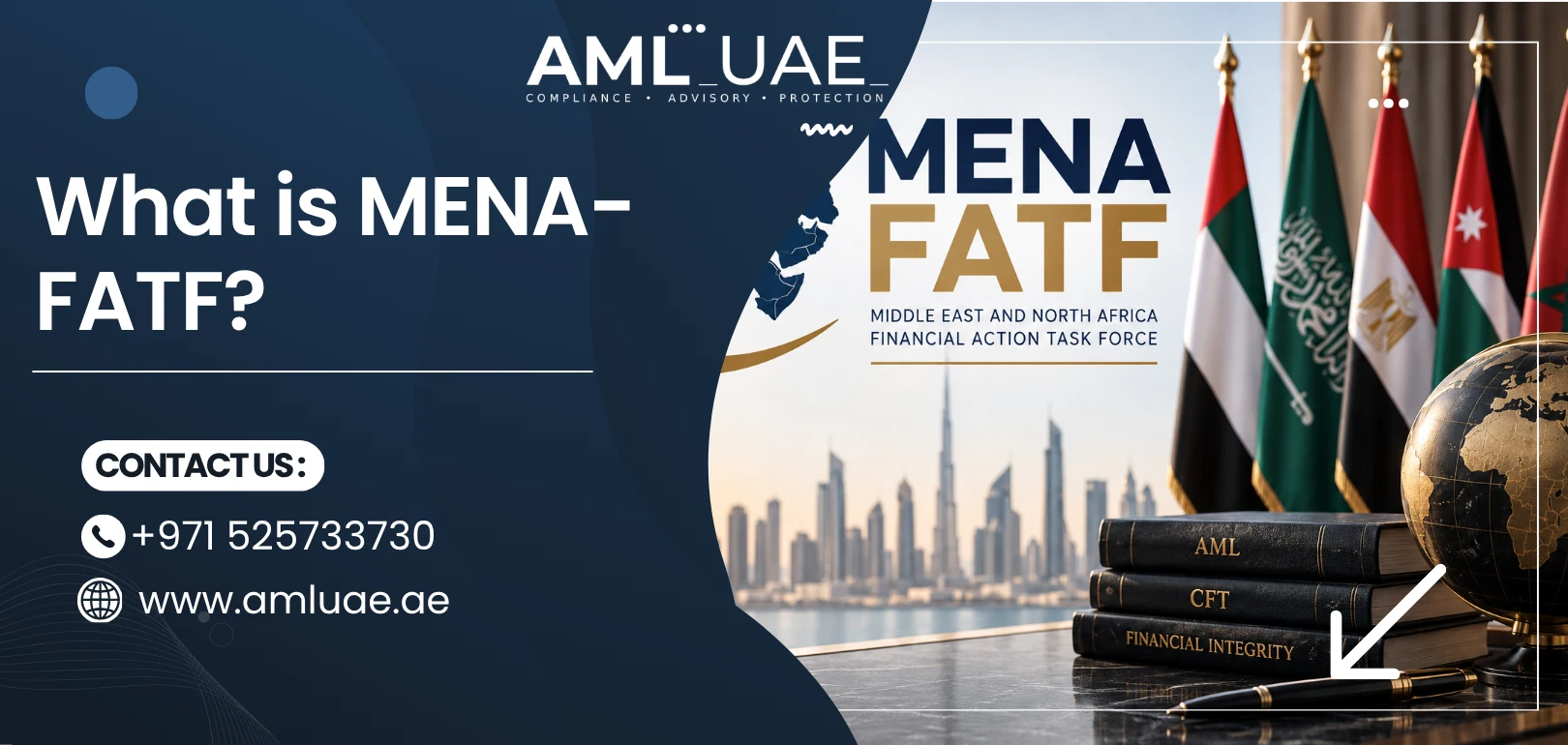
MENAFATF, or the Middle East and North Africa Financial Action Task Force, is a FATF-Style Regional Body (FSRB) responsible for strengthening anti-money laundering, counter-terrorist financing, and counter-proliferation financing standards across the Middle East and North Africa region.
Table of Contents
ToggleEstablished in November 2004, MENAFATF works with its member countries to promote the implementation of the FATF Recommendations, support mutual evaluations, facilitate regional cooperation, identify money laundering and terrorist financing risks, and strengthen AML/CFT capabilities. Its headquarters are in Bahrain.
For businesses searching for information about aml uae, uae aml, aml in uae, or the relationship between MENAFATF and UAE AML compliance, understanding the organization’s role is important because the UAE is one of MENAFATF’s member countries and its AML/CFT framework is assessed within the FATF global network.
Key Takeaways
MENAFATF is a regional body within the global FATF network that focuses on combating money laundering, terrorist financing, and proliferation financing in the Middle East and North Africa.
It was established in Manama, Bahrain, on 30 November 2004 by 14 governments and is voluntary and cooperative in nature. It operates independently while cooperating with FATF and other international organizations.
MENAFATF currently lists 21 member countries, including the United Arab Emirates. Its current observer list includes countries and international organizations such as France, the United Kingdom, the United States, Spain, Australia, Germany, Italy, FATF, the IMF, the World Bank, GCC, Egmont Group, APG, WCO, Arab Monetary Fund, EAG, the United Nations, and the European Commission.
MENAFATF also conducts mutual evaluations of member jurisdictions against international AML/CFT standards. In 2026, the organization is preparing member countries for the third round of mutual evaluations.
For UAE businesses, MENAFATF is relevant because the UAE’s AML/CFT system is evaluated through the FATF-MENAFATF framework, with the UAE’s most recent published mutual evaluation dating from 2020 and a further assessment scheduled in the current FATF assessment calendar.
What Is MENAFATF?
MENAFATF stands for Middle East and North Africa Financial Action Task Force.
It is a FATF-Style Regional Body established to help countries in the MENA region implement international standards for combating money laundering, terrorist financing and proliferation financing.
FATF describes MENAFATF as one of the FATF-Style Regional Bodies that form part of the global AML/CFT network. FATF explains that the FSRBs have an important role in promoting effective implementation of the FATF Recommendations among their members and providing expertise and input into FATF policy-making.
In practical terms, MENAFATF provides a regional mechanism through which member countries cooperate, exchange information and experience, undergo mutual evaluations, develop regional responses to financial crime risks, and receive technical assistance and training.
What Does MENAFATF Stand For?
The full form of MENAFATF is Middle East and North Africa Financial Action Task Force.
The name reflects its geographical focus and its relationship with the broader FATF system. Although MENAFATF is regional, its work is connected to international AML/CFT standards developed through the FATF global network.
This distinction is important. MENAFATF is not simply another name for FATF. Instead, it is a regional body that works within the FATF global network and supports the implementation and assessment of international standards across its member jurisdictions.
When Was MENAFATF Established?
MENAFATF was established on 30 November 2004 at an inaugural ministerial meeting in Manama, Bahrain.
Fourteen countries originally agreed to establish the organization as a FATF-Style Regional Body. The headquarters were established in Bahrain. MENAFATF describes itself as voluntary and cooperative in nature and independent of other international organizations, while cooperating with bodies such as FATF.
The organization was created in response to the need for greater regional cooperation against money laundering and terrorist financing and to support the implementation of internationally accepted standards in the MENA region.
What Is the Purpose of MENAFATF?
MENAFATF’s objectives extend beyond simply monitoring AML compliance.
Its official objectives include adopting and implementing the FATF Recommendations relating to money laundering, terrorist financing and proliferation financing, implementing relevant United Nations treaties and Security Council resolutions, improving compliance with international standards across the MENA region, cooperating with international and regional organizations, identifying regional money laundering and terrorist financing issues, sharing experience and developing solutions.
This regional cooperation is particularly important because financial crime does not stop at national borders. Criminal proceeds, shell companies, trade transactions, digital assets, remittances, and other financial channels can involve multiple jurisdictions.
Does your real estate agency’s AML framework pass a Ministry of Economy inspection standard?
AMLUAE’s AML/CFT Health Check, delivered by specialist AML compliance consultants, assesses every element inspectors check, giving you a gap report and remediation roadmap before a regulator arrives.
What Does MENAFATF Do?
MENAFATF performs several functions that directly contribute to the regional AML/CFT framework.
One of its most important functions is supporting mutual evaluations. Member jurisdictions undergo peer assessments designed to examine their technical compliance with international standards and the effectiveness of their AML/CFT systems. MENAFATF brings together trained experts from member jurisdictions, including legal, financial, regulatory, and law enforcement specialists.
MENAFATF also works on typologies, technical assistance, training, and regional cooperation. Its work helps member countries understand emerging money laundering and terrorist financing methods and develop appropriate responses.
In 2026, MENAFATF’s priorities include preparing member countries for the third round of mutual evaluations, strengthening governance and supporting implementation of FATF recommendations and international standards.
Who Are the Members of MENAFATF?
MENAFATF currently lists 21 member countries on its official website. The current list includes:
Algeria, Bahrain, Djibouti, Egypt, Iraq, Jordan, Kuwait, Lebanon, Libya, Mauritania, Morocco, Oman, Palestine, Qatar, Saudi Arabia, Somalia, Sudan, Syria, Tunisia, United Arab Emirates, and Yemen.
For businesses researching MENAFATF members, MENAFATF countries, or MENAFATF member countries, the official MENAFATF member directory should be treated as the authoritative source because membership information can change.
Is the UAE a MENAFATF Member?
Yes. The United Arab Emirates is a member of MENAFATF.
The UAE is also part of the wider FATF global network through MENAFATF. FATF identifies MENAFATF as the FATF-Style Regional Body covering the Middle East and North Africa and lists the UAE under the MENAFATF regional network.
This makes MENAFATF particularly relevant to businesses operating in the UAE because regional AML standards, mutual evaluations, and financial crime risks are directly connected to the UAE’s broader compliance environment.
Who Are the Observers of MENAFATF?
MENAFATF has both country and organizational observers.
The current official MENAFATF observer list includes France, the United Kingdom, the United States, Spain, Australia, Germany and Italy, together with international and regional organizations including the International Monetary Fund, World Bank, Gulf Cooperation Council, FATF, Egmont Group of Financial Intelligence Units, Asia/Pacific Group on Money Laundering, World Customs Organization, Arab Monetary Fund, Eurasian Group, United Nations and European Commission.
Observer status provides a mechanism for cooperation and participation without being the same as full MENAFATF membership.
The distinction is important because the current official observer list has changed over time. For example, MENAFATF announced in May 2026 that Italy had become an Observer Member.
What Is the Difference Between MENAFATF Members and Observers?
Members are the jurisdictions that participate as full member countries of MENAFATF and undertake the commitments associated with membership.
Observers are countries or organizations that participate in MENAFATF activities under observer status. Their involvement can support technical cooperation, knowledge sharing, training, and coordination with the broader AML/CFT community.
MENAFATF’s accession criteria distinguish between membership and observer status, including different participation and contribution expectations.
For SEO and research purposes, it is therefore better to use separate terms such as MENAFATF members, MENAFATF observers, MENAFATF observer countries and MENAFATF observer organizations, rather than treating all participants as members.
How Is MENAFATF Connected to FATF?
FATF and MENAFATF are separate organizations, but they are closely connected.
FATF develops international standards for combating money laundering, terrorist financing, and proliferation financing. MENAFATF operates as a FATF-Style Regional Body and helps its members implement those standards at the regional level. FATF identifies MENAFATF as part of its global network of nine FSRBs.
FATF also explains that FSRBs have an essential role in promoting implementation of the FATF Recommendations and providing regional expertise.
Therefore, when a business asks about MENAFATF vs FATF, the relationship can be summarized simply: FATF establishes the global standards, while MENAFATF provides a regional framework for implementing and assessing those standards among its members.
MENAFATF vs FATF: What Is the Difference?
FATF | MENAFATF |
Global intergovernmental standard-setting body | Regional FATF-Style Regional Body |
Develops international AML/CFT/CPF standards | Supports implementation of those standards in the MENA region |
Works through its global network | Covers member jurisdictions in the Middle East and North Africa |
Conducts or oversees relevant mutual evaluations | Conducts mutual evaluations of its members |
Works with FSRBs | Is itself an FSRB |
The two should therefore not be treated as competing organizations. MENAFATF is part of the global network through which FATF standards are implemented across jurisdictions.
What Are MENAFATF Mutual Evaluations?
A MENAFATF mutual evaluation is a peer assessment of a member jurisdiction’s AML/CFT framework.
The evaluation examines both technical compliance and effectiveness. MENAFATF states that evaluation teams are drawn from member jurisdictions and include legal, financial, regulatory, and law enforcement experts.
A mutual evaluation is therefore much broader than checking whether a country has AML legislation.
It can examine whether the jurisdiction understands its money laundering and terrorist financing risks, has appropriate legal and institutional arrangements, applies preventive measures effectively, investigates and prosecutes financial crime, uses financial intelligence effectively, and achieves appropriate outcomes.
What Is the Third Round of MENAFATF Mutual Evaluations?
MENAFATF is moving into its third round of mutual evaluations.
MENAFATF’s 2026 presidency has identified readiness for the third round as a major priority. The organization’s current leadership has also stated that the third round has commenced, with countries at different stages of the evaluation process.
The third round reflects the evolving FATF assessment framework, which places significant emphasis on effectiveness in addition to technical compliance.
For businesses, this means AML programs should not merely exist on paper. Businesses need to demonstrate that their AML controls operate in practice and are appropriate to their risks.
UAE FATF Mutual Evaluation 2026
The phrase UAE FATF Mutual Evaluation 2026 is increasingly relevant to UAE AML compliance discussions.
The UAE’s most recent published comprehensive mutual evaluation was conducted jointly through the FATF-MENAFATF framework and published in 2020. FATF describes that assessment as a review of the UAE’s AML/CFT system, including its compliance with the FATF Recommendations and the effectiveness of its measures.
The current FATF assessment calendar lists the UAE’s assessment body as FATF-MENAFATF, records the last evaluation as April 2020, and lists a possible on-site period beginning in June 2026 with a possible plenary discussion in February 2027. FATF notes that assessment schedules can change.
This makes 2026 particularly important for UAE businesses and compliance professionals because effective AML controls, risk assessments, CDD, beneficial ownership controls, transaction monitoring, suspicious transaction reporting and governance remain relevant to the wider national AML/CFT framework.
What Was the UAE’s Previous FATF Mutual Evaluation?
The UAE’s previous comprehensive mutual evaluation was published in 2020.
The assessment was conducted through FATF and MENAFATF and evaluated the UAE’s measures against money laundering and terrorist financing, including the effectiveness of its AML/CFT framework.
The UAE subsequently underwent follow-up processes. FATF’s 2023 follow-up report recorded improvements in the UAE’s technical compliance ratings and stated that the country remained in enhanced follow-up at that time.
These historical assessments are important context, but they should not be confused with the status of the current 2026 assessment process.
What Does MENAFATF Mean for UAE Businesses?
MENAFATF’s work may seem focused on governments and regulators, but it has practical implications for businesses.
Financial institutions and relevant DNFBPs are part of the broader AML ecosystem. Their customer due diligence, beneficial ownership verification, risk assessments, transaction monitoring, sanctions screening, record-keeping, suspicious transaction reporting, and employee training all contribute to the effectiveness of the national AML/CFT framework.
This is why UAE AML compliance should be treated as an ongoing business process rather than simply a regulatory document.
Businesses should understand their applicable obligations, identify their financial crime risks and implement controls that are proportionate to those risks.
UAE Money Laundering Compliance and MENAFATF
UAE money laundering controls operate within a wider international and regional framework.
MENAFATF provides the regional AML/CFT structure, while the UAE implements its own laws, regulations, supervisory requirements and institutional arrangements.
For businesses, this means that understanding MENAFATF alone is not enough. Companies also need to understand the UAE-specific requirements that apply to their sector.
A strong AML in UAE framework should connect regulatory requirements with practical controls, including customer due diligence, beneficial ownership checks, risk assessment, transaction monitoring, and suspicious transaction reporting.
What Is the Role of Risk Assessment in MENAFATF Compliance?
Risk assessment is central to modern AML compliance.
A business should understand the risks associated with its customers, products, services, delivery channels, and geographic exposure. It should then apply controls proportionate to those risks.
This principle is important because AML compliance is not simply about collecting the same documents from every customer.
A risk-based framework may influence customer onboarding, KYC refresh, enhanced due diligence, transaction monitoring, sanctions screening, customer risk ratings, and ongoing review.
What Is the Relationship Between MENAFATF and AML Training?
Training is an important component of AML/CFT capacity building.
MENAFATF supports training and technical assistance for member countries, while businesses have their own obligations to ensure relevant employees understand the AML controls applicable to their roles.
For businesses searching for AML training courses in Dubai, the focus should be on practical UAE AML requirements rather than generic international theory.
Effective AML training can cover customer due diligence, beneficial ownership, risk assessment, suspicious transaction indicators, sanctions, PEPs, transaction monitoring, internal escalation, and reporting obligations.
What Is GoAML Training?
GoAML is the platform used by the UAE Financial Intelligence Unit for relevant suspicious transaction and suspicious activity reporting.
GoAML training helps relevant compliance personnel understand reporting procedures, information requirements, internal escalation, and submission processes.
GoAML is therefore connected to the broader UAE AML framework, although it should not be confused with MENAFATF itself.
MENAFATF operates at the regional level, while GoAML is part of the UAE’s national suspicious transaction reporting infrastructure.
Does the FATF Grey List Affect MENAFATF Members?
The phrase gray list countries 2026 is commonly used to describe countries on FATF’s list of jurisdictions under increased monitoring.
FATF itself uses the term “jurisdictions under increased monitoring.” The June 2026 FATF statement notes that the list is often externally called the “grey list.” FATF also explicitly states that inclusion does not call for automatic enhanced due diligence or blanket de-risking and that jurisdictions should apply a risk-based approach.
This distinction is important for UAE businesses.
A country appearing on the FATF increased-monitoring list should not automatically cause a business to reject every customer connected to that country. Instead, the business should consider the relevant geographic risk alongside customer type, ownership, products, transactions, and other risk indicators.
How Can AML Compliance Software Support Businesses?
Technology can help businesses implement AML controls more consistently.
AML compliance software may support KYC management, customer risk scoring, document tracking, sanctions screening, PEP screening, adverse-media monitoring, transaction monitoring, case management, and audit trails.
However, technology does not replace a risk-based compliance program.
Businesses still need appropriately designed policies, trained employees, management oversight and professional judgement.
For larger businesses, AML compliance software can become particularly useful when the organization has a large customer base or complex review requirements.
What Are AML Advisory Services?
Businesses may require professional support to interpret applicable requirements and translate them into practical controls.
AML advisory services can include AML/CFT policy development, business-wide risk assessments, customer risk assessment frameworks, KYC and CDD procedures, Re-KYC processes, transaction monitoring frameworks, sanctions screening, and compliance health checks.
An AML advisor may also help management understand gaps between documented procedures and actual compliance practices.
When Should a Business Work With AML Consultants?
Businesses may engage AML consultants when they are establishing an AML framework, preparing for regulatory reviews, updating their risk assessment, improving customer due diligence, or reviewing existing compliance controls.
An AML consultant can help identify gaps, develop procedures, and support implementation.
An AML compliance consultant may focus specifically on designing and improving AML/CFT compliance frameworks, while an anti-money laundering expert may provide specialist advice on financial crime risks, investigations, controls and regulatory expectations.
The title used by a provider is less important than its actual expertise, relevant qualifications, UAE regulatory knowledge, and ability to provide practical compliance support.
What Are AML Compliance Solutions?
AML compliance solutions can include policies, procedures, risk assessments, KYC systems, customer screening, transaction monitoring, employee training, and reporting controls.
For a UAE business, the right solution depends on the organization’s sector, customer profile, geographic exposure, products and services.
There is no single AML solution that is appropriate for every business.
How Can AML UAE Help?
AML UAE provides AML and regulatory compliance support for businesses operating in the UAE.
Businesses may seek AML services covering AML/CFT policies, risk assessments, KYC and CDD, Re-KYC, compliance health checks, regulatory reporting, employee training, GoAML support, and ongoing advisory.
Businesses looking for AML compliance Dubai support can also consider professional assistance with implementing practical AML controls rather than relying only on generic policy templates.
AML UAE can also support organizations seeking compliance services UAE, particularly where they need help connecting regulatory expectations with operational compliance procedures.
Regulatory Compliance Advisory UAE
Regulatory compliance extends beyond AML.
Businesses may need support understanding regulatory obligations, implementing controls, maintaining documentation, training employees, and monitoring compliance performance.
Regulatory compliance advisory UAE services can help businesses establish processes that align their operational activities with relevant regulatory requirements.
Similarly, organizations searching for regulatory compliance services UAE or regulatory compliance services in UAE should consider whether the provider understands the specific regulatory environment applicable to their sector.
Chartered AML Consultants and AML Professionals
Businesses sometimes search for chartered AML consultants, money laundering expert or anti-money laundering expert when they need specialist support.
Professional credentials can be useful indicators of expertise, but businesses should also assess practical experience, industry knowledge, understanding of UAE requirements, and the provider’s ability to implement compliance controls.
The same principle applies when selecting an AML advisor or AML consultant.
AML Compliance and Tax Compliance Are Different
AML compliance and tax compliance are separate areas of professional responsibility.
A tax consultant may provide advice relating to taxation, VAT, corporate tax and other tax matters, while AML professionals focus on money laundering, terrorist financing, customer due diligence, financial crime risk and related compliance requirements.
Businesses may need both types of professional support, but they should not assume that tax expertise automatically means AML expertise.
What Businesses Should Know About MENAFATF in 2026
The 2026 MENAFATF environment is particularly significant because the organization is preparing member jurisdictions for the third round of mutual evaluations.
MENAFATF’s current presidency has emphasized readiness, governance, innovation, and stronger regional integration with the FATF global network. The current MENAFATF President for 2026 is H.E. Hamid Saif Al Zaabi.
MENAFATF has also continued regional cooperation around emerging financial crime risks, including illicit financial flows, sanctions evasion, terrorist financing, and other forms of financial crime.
For businesses, this reinforces the importance of maintaining effective AML controls rather than treating compliance as a one-time project.
What Businesses Should Know About MENAFATF in 2026
MENAFATF is a central component of the global AML/CFT network for the Middle East and North Africa. Established in 2004, it supports member countries through FATF standards implementation, mutual evaluations, technical assistance, training, typology work, and regional cooperation.
The UAE is one of MENAFATF’s 21 member countries, making the organization’s activities particularly relevant to businesses operating in the Emirates.
The 2026 environment is especially significant because MENAFATF is preparing jurisdictions for the third round of mutual evaluations, while the FATF assessment calendar currently lists the UAE for a possible 2026 onsite assessment and 2027 plenary discussion.
For businesses, the practical lesson is straightforward: understanding MENAFATF should lead to stronger implementation of AML controls, not simply greater awareness of the organization. Effective KYC, customer due diligence, beneficial ownership verification, risk assessment, transaction monitoring, sanctions screening, employee training, and suspicious transaction reporting remain important components of a credible AML framework.
Businesses looking for AML UAE, AML advisory services, AML compliance solutions, AML services, AML compliance consultant, AML consultants, regulatory compliance advisory UAE, or regulatory compliance services in UAE can seek professional assistance to develop and maintain an AML framework appropriate to their activities and risk profile.
Why Choose AML UAE for AML Compliance Support?
AML UAE supports businesses with practical AML and regulatory compliance requirements across the UAE.
Its services can include AML/CFT policy documentation, AML risk assessments, KYC and CDD procedures, Re-KYC support, AML compliance health checks, regulatory reporting, employee AML training, GoAML support, AML compliance software guidance, and ongoing AML advisory services.
Whether a business requires an AML advisor, AML consultant, money laundering expert, anti-money laundering expert, or broader compliance services UAE, professional support should be tailored to the organization’s actual risk exposure and applicable regulatory requirements.
Get Expert AML Support From AML UAE
Call: +971 52 573 3730
Email: connect@amluae.ae